 Serengeti Safari Packages
Olduvai Gorge: Tanzania's Cradle of Mankind
Olduvai Gorge is the steep-sided ravine in northern Tanzania where some of the most important early human fossils ever found came out of the ground. It sits inside the Ngorongoro Conservation Area, on the road most safari vehicles already drive between the Ngorongoro Crater and the Serengeti. This guide covers where the gorge is, how long and deep it is, the Leakey family finds that made it famous, the Laetoli footprints nearby, the museum on the rim and what entry costs, and which Serengeti safari packages stop here. Figures come from Wikipedia, the NCAA website and the NCAA tariff, and the tour details come from the comparison of bookable trips.
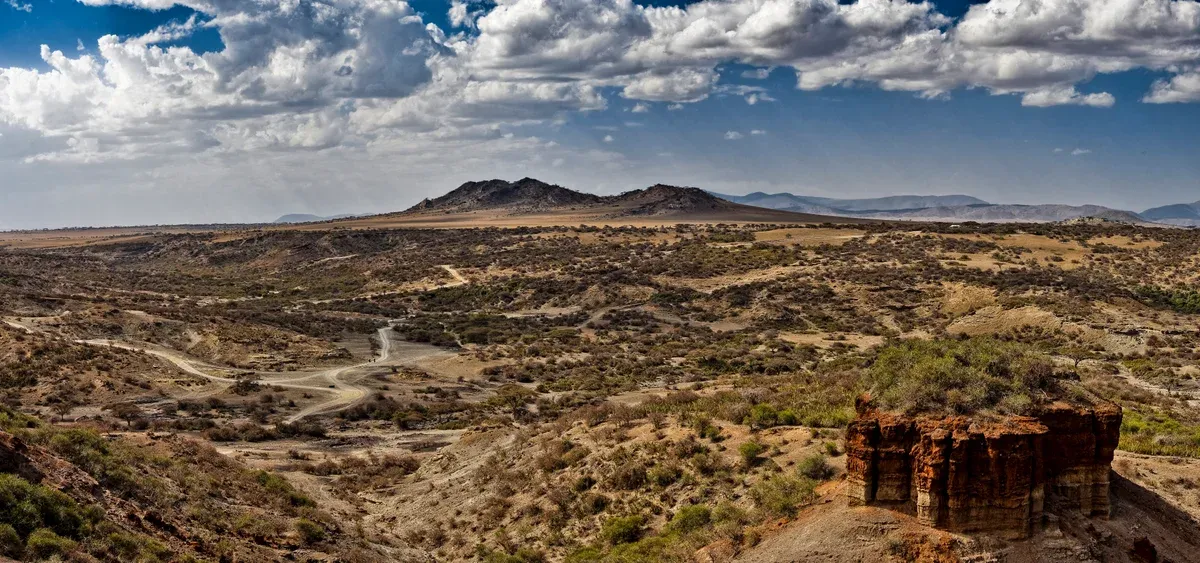
Olduvai Gorge, seen from the museum. Photo: Noel Feans, CC BY 2.0, via Wikimedia Commons
Quick answer Olduvai Gorge at a glance
Olduvai Gorge is a 48 km long ravine, cut up to 90 m deep into the eastern Serengeti Plains, where the Leakey family found early human fossils including the 1959 Zinjanthropus skull. It lies in the Ngorongoro Conservation Area on the road between the crater and the Serengeti, so overland safaris between the two pass its turnoff.
Key takeaways
- Entry for non-East African adults is USD 35.40 per the NCAA tariff, with children aged 5 to 15 at USD 11.80.
- The 4-Day Serengeti Camping Safari stops at Olduvai on day 3 as an optional visit with an extra museum fee.
- The 3-Day Serengeti Big Five Safari drives through the Ngorongoro Conservation Area where the gorge sits.
- Compare trip styles, prices and park fee rules on the homepage comparison table.
Where It Is and Why It Matters
Olduvai Gorge sits in the Ngorongoro Conservation Area on the eastern edge of the Serengeti Plains, at the point almost every road safari between Arusha and the Serengeti already passes.
The Gorge in Numbers
The gorge is a registered National Historic Site of Tanzania, cut into Pleistocene lake-bed sediments in the eastern Serengeti Plains. It lies about 45 km from Laetoli and about 25 km downstream of Lake Ndutu and Lake Masek. Ash from the Olmoti and Kerimasi volcanoes helped preserve the fossils buried in its layers. In 2010 the Ngorongoro Conservation Area gained mixed natural and cultural World Heritage status because of Olduvai Gorge, and in 2022 the IUGS listed the Laetoli and Olduvai palaeoanthropological sites among its first 100 geological heritage sites. The table below pulls together the core figures and where each one comes from.
Wikipedia's Olduvai article and its Ngorongoro Conservation Area article disagree on the length by 2 km, so both figures are given. For the crater itself and the wider conservation area, see the page on the Ngorongoro Crater.
| Fact | Figure | Source |
|---|---|---|
| Gorge length | 48 km (about 50 km in the NCA article) | Wikipedia |
| Gorge depth | Up to 90 m (300 ft) | Wikipedia |
| Distance from Laetoli | About 45 km | Wikipedia |
| Downstream of Lake Ndutu and Lake Masek | About 25 km | Wikipedia |
| Status | National Historic Site of Tanzania, IUGS geological heritage site 2022 | Wikipedia |
| World Heritage | NCA gained mixed status in 2010 because of Olduvai Gorge | Wikipedia |
Why the Name Is Spelled Two Ways
Both spellings are correct. The name comes from the Maasai word oldupai, meaning the place of the wild sisal, after the plant Dracaena hanningtonii that grows in the gorge. The German scientist Wilhelm Kattwinkel recorded it as Oldoway when he visited in 1911 while studying sleeping sickness, and the spelling Olduvai stuck in English. The Ngorongoro Conservation Area Authority today calls it Oldupai Gorge in its own rules, so you will see both on signs and documents. The NCAA rules require a licensed guide for all visitors to Oldupai Gorge and forbid disturbing or removing geological or archaeological deposits.
Kattwinkel's 1911 visit found bones of an extinct three-toed horse, which started the scientific interest. Hans Reck led an expedition in 1913 that found hominin remains and identified five deposit layers named Beds I to V. Louis Leakey's 1931 expedition found hand axes near camp, and Mary Leakey first visited in 1935. At the turnoff from the Ngorongoro-Serengeti road stands a monument erected in 2019 with two 6 ft concrete skulls of Paranthropus boisei and Homo habilis by the sculptor Festo Kijo, a hard landmark to miss from the road.
Sources: Wikipedia, Serengeti National Park, Ngorongoro Conservation Area Authority tariffs
The Finds
Olduvai is famous because the Leakey family turned it into the most productive early human site in East Africa, with over 85 hominid specimens found so far.
The Skulls That Changed the Story
The find that made the gorge famous came on 17 July 1959, when Mary Leakey found the skull fragment of Zinjanthropus boisei, now catalogued OH 5 and classified as Paranthropus boisei. Louis Leakey described it about a month later. The site is called FLK, named for Frida Leakey with K for korongo, the Swahili word for gully. The skull was nicknamed Nutcracker Man and Dear Boy. Paranthropus boisei lived about 2.5 to 1.15 million years ago, averaged 487.5 cc of brain volume across 10 known specimens and ate mostly C4 plants such as grasses and sedges.
A year later the story moved on. Jonathan Leakey found the mandible at FLK North-North in May 1960 that became the type specimen of Homo habilis, called OH 7. Leakey, Tobias and Napier named the species in 1964 as handy man. Heselon Mukiri had found a Homo habilis molar, OH 4, in 1959, though nobody recognised it at the time. A Homo erectus pelvis and femur later came from site WK in Bed IV. Stone tools matter here too: Louis Leakey first described the Oldowan industry in 1951, and Garniss Curtis dated Bed I tools to 1.7 million years by potassium-argon dating, while site HK in Bed IV yielded about 500 hand axes and cleavers.
| Year | Find | Who |
|---|---|---|
| 1911 | Bones of an extinct three-toed horse | Wilhelm Kattwinkel |
| 1913 | Hominin remains, Beds I to V defined | Hans Reck's expedition |
| 1931 | Hand axes found near camp | Louis Leakey's expedition |
| 1959 | Molar OH 4 (Homo habilis, not recognised at the time) | Heselon Mukiri |
| 1959 | Zinjanthropus boisei skull OH 5 at FLK on 17 July | Mary Leakey |
| 1960 | Homo habilis type mandible OH 7 at FLK North-North in May | Jonathan Leakey |
| 1973 | Ndutu cranium excavated at Lake Ndutu, estimated 500,000 to 600,000 years old | Excavation team at Lake Ndutu |
The Laetoli Footprints Nearby
About 45 km from the gorge, the Laetoli footprint trail is the other headline site. Mary Leakey's team found the trail in 1976 and had excavated it by 1978, with the wider excavation running from 1976 to 1981. The prints are preserved in a volcanic ash layer about 15 cm thick. Wikipedia dates the footprints to about 3.7 million years ago, while the Mary Leakey article dates the ash to about 3.6 million years, so both ages circulate. The trail is a 24 m line of prints made by three hominins, one walking in another's footsteps, and is most often attributed to Australopithecus afarensis. One individual had a foot length of 21.5 cm and an estimated height of 1.34 to 1.56 m, another 18.5 cm and 1.15 to 1.34 m. Prints of about twenty other animal species sit in the same ash layer.
The prints were reburied in 1979. A 1992 trench by the Getty Conservation Institute and Tanzanian authorities found root damage, which led to conservation work in 1993. A 2015 dig at Site S, about 150 m south of Site G, found prints of a hominin larger than any of the Site G trio. Entry to the Laetoli Footprints site costs USD 23.60 for adults and USD 11.80 for children aged 5 to 15 per the NCAA tariff.
Olduvai - The Cradle of Humankind ENG
The Olduvai Gorge excavations and what they revealed about early humans. Third-party video by Scuola di Paleoantropologia. This site did not shoot it and has no relationship with the creator.
Visiting the Museum
The Olduvai Gorge Museum sits on the gorge rim past the road turnoff, and a stop fits into almost any overland safari itinerary through the conservation area.
Fee, Distance and Access
The museum lies 5 km beyond the monument on the gorge rim. The NCAA's own page gives the distance two ways, as six kilometers from the main road junction and as 5 kilometers beyond the monument. Check opening hours with your guide. Entry is priced per the NCAA tariff: the table below sets out what you pay.
The gorge sits inside the Ngorongoro Conservation Area, so a safari that transits the area on the way to the Serengeti passes the turnoff anyway. The crater descent has its own charges, described on the Ngorongoro Crater page. One note on the sources: the NCAA museum page gives no separate museum fee, and the USD 35.40 figure below is the tariff line for Olduvai Gorge entry for non-East African adults.
| Item | Fee | Source |
|---|---|---|
| Olduvai Gorge entry, non-East African adult | USD 35.40 | NCAA tariff |
| Olduvai Gorge entry, child 5 to 15 | USD 11.80 | NCAA tariff |
| Laetoli Footprints, adult | USD 23.60 | NCAA tariff |
| Laetoli Footprints, child 5 to 15 | USD 11.80 | NCAA tariff |
| Museum distance from the road | 6 km from the junction, 5 km beyond the monument | NCAA |
Packages That Stop at Olduvai
Only some bookable trips list the gorge as a stop, so check before you book. The 4-Day Serengeti Camping Safari at $950 per person runs the gorge visit on day 3 as an optional extra, and the listing says the optional Olduvai Gorge visit carries an extra museum fee, amount not stated, so budget for it separately. That tour includes entrance fees, 3 nights of camping with sleeping bags provided and a shared vehicle with 6 clients plus the driver and the chef, and it holds a 4.4 score from 51 reviews.
If you want a shorter trip through the same area, the 3-Day Serengeti Big Five Safari at $900 per person includes all park fees and covers the Serengeti and Ngorongoro with 2 nights of camping, though its listing does not name a gorge stop. The 3-Day Serengeti Safari with Balloon at $900 per person covers the same parks with an optional dawn balloon flight on day 2. For a lodge-based alternative that drives the same road, see the 4-Day Serengeti Mid-Range Safari page.
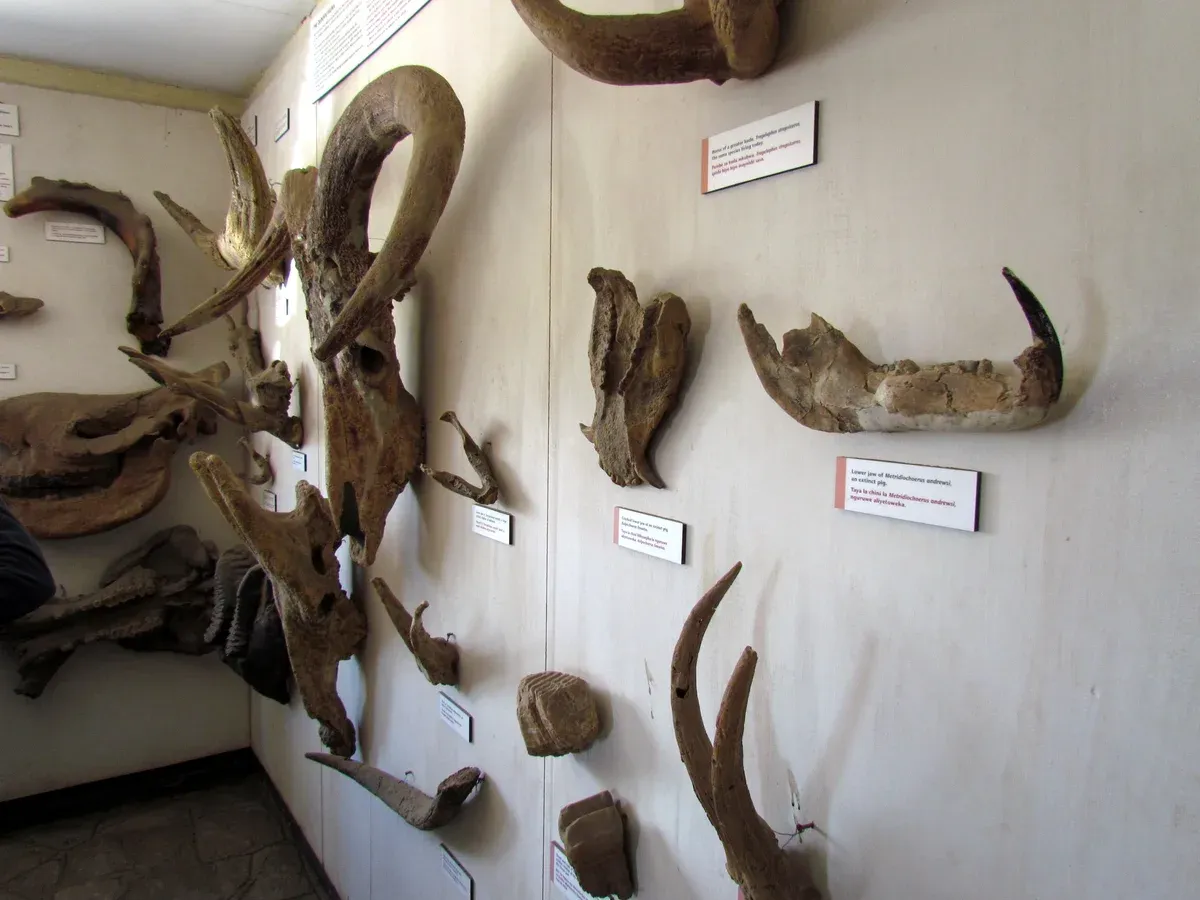
Fossils on display inside the Olduvai Museum. Photo: David Berkowitz, CC BY 2.0, via Wikimedia Commons
Tips for Visiting Olduvai Gorge
The rules below come from the NCAA regulations and tariff and from the tour listings on this site.
Do
- Do take a licensed guide, because the NCAA rules require a licensed guide for all visitors to Oldupai Gorge.
- Do confirm the museum fee with your operator before the stop, because the 4-Day Serengeti Camping Safari lists the Olduvai visit as optional with an extra fee of an amount not stated.
- Do ask your operator how the entry fee is paid, because the NCAA tariff quotes the USD 35.40 entry figure and says nothing on payment method.
- Do plan the stop around the monument turnoff, because the museum sits 5 km beyond the monument, which the NCAA also gives as 6 km from the main road junction.
- Do pair the gorge with Laetoli if your itinerary allows, because the two sites are about 45 km apart and entry to Laetoli costs USD 23.60 per adult.
Don't
- Don't disturb or remove geological or archaeological deposits, because the NCAA rules forbid it.
- Don't expect the stop to be free on a tour that offers it, because optional visits carry the extra museum fee noted on the tour listing.
- Don't drive over 25 km/h inside the conservation area, because Altezza Travel gives 25 km/h as the maximum speed in the Ngorongoro Conservation Area.
- Don't confuse the Olduvai entry fee with the crater fee, because the crater descent has its own charges described on the Ngorongoro Crater page.
Olduvai Gorge FAQ
Why is Olduvai Gorge famous?
It is famous as one of the most productive early human sites in the world, with over 85 hominid specimens found there, including the 1959 Zinjanthropus skull and the Homo habilis type specimen. The gorge is a National Historic Site of Tanzania and gave the Ngorongoro Conservation Area its mixed cultural World Heritage status in 2010. See the Olduvai Gorge guide for the full find list.
How old is the skull found in Olduvai Gorge?
The skull OH 5, Paranthropus boisei, belonged to a species that lived about 2.5 to 1.15 million years ago, and the oldest Olduvai fossils are dated to 1.89 million years, with hominid occupation in the area running back at least 1.75 million years by another measure. The nearby Laetoli footprints are far older, dated to about 3.6 to 3.7 million years.
Is Olduvai Gorge worth visiting?
For most safari travellers the answer is yes, because the turnoff sits on the road between the crater and the Serengeti that road safaris drive anyway, so the detour is small. The monument at the turnoff carries two 6 ft concrete skulls, and the museum on the rim is 5 km beyond it. If you are planning the wider area, the Ngorongoro Crater guide covers the crater itself.
What is the entrance fee for Olduvai Gorge?
The NCAA tariff lists Olduvai Gorge entry for non-East African adults at USD 35.40 and children aged 5 to 15 at USD 11.80. Laetoli costs USD 23.60 per adult and USD 11.80 per child. A separate museum fee beyond this tariff line is not stated, and the 4-Day Serengeti Camping Safari notes an optional Olduvai stop with an extra museum fee of an amount not stated.
Which safaris stop at Olduvai Gorge?
The 4-Day Serengeti Camping Safari at $950 per person lists the gorge visit on day 3 as an optional extra. The 3-Day Serengeti Big Five Safari and the 3-Day Serengeti Safari with Balloon, both at $900 per person, drive through the conservation area where the gorge sits, though their listings do not name a stop. Check the homepage comparison table for what each trip includes.
How long is Olduvai Gorge and how deep?
Wikipedia gives the gorge as 48 km long and cut up to 90 m deep, while Wikipedia's Ngorongoro Conservation Area article says about 50 km, a 2 km difference between the two sources. It was cut into Pleistocene lake-bed sediments in the eastern Serengeti Plains, about 25 km downstream of Lake Ndutu and Lake Masek.