 Serengeti Safari Packages
Tsetse Fly Tanzania
The tsetse fly is the insect every northern Tanzania safari traveller hears about. It bites hard, it likes blue and black clothing, and it can carry the parasite that causes sleeping sickness. This guide explains what the fly is, where you meet it on the Serengeti circuit, what the real disease risk is for a short safari, and which clothes and habits cut the number of bites. The figures come from the WHO, the CDC and published research. When a topic belongs to another page, such as general safari clothing, it is linked instead of repeated. Compare Serengeti safari packages once you know what to pack.
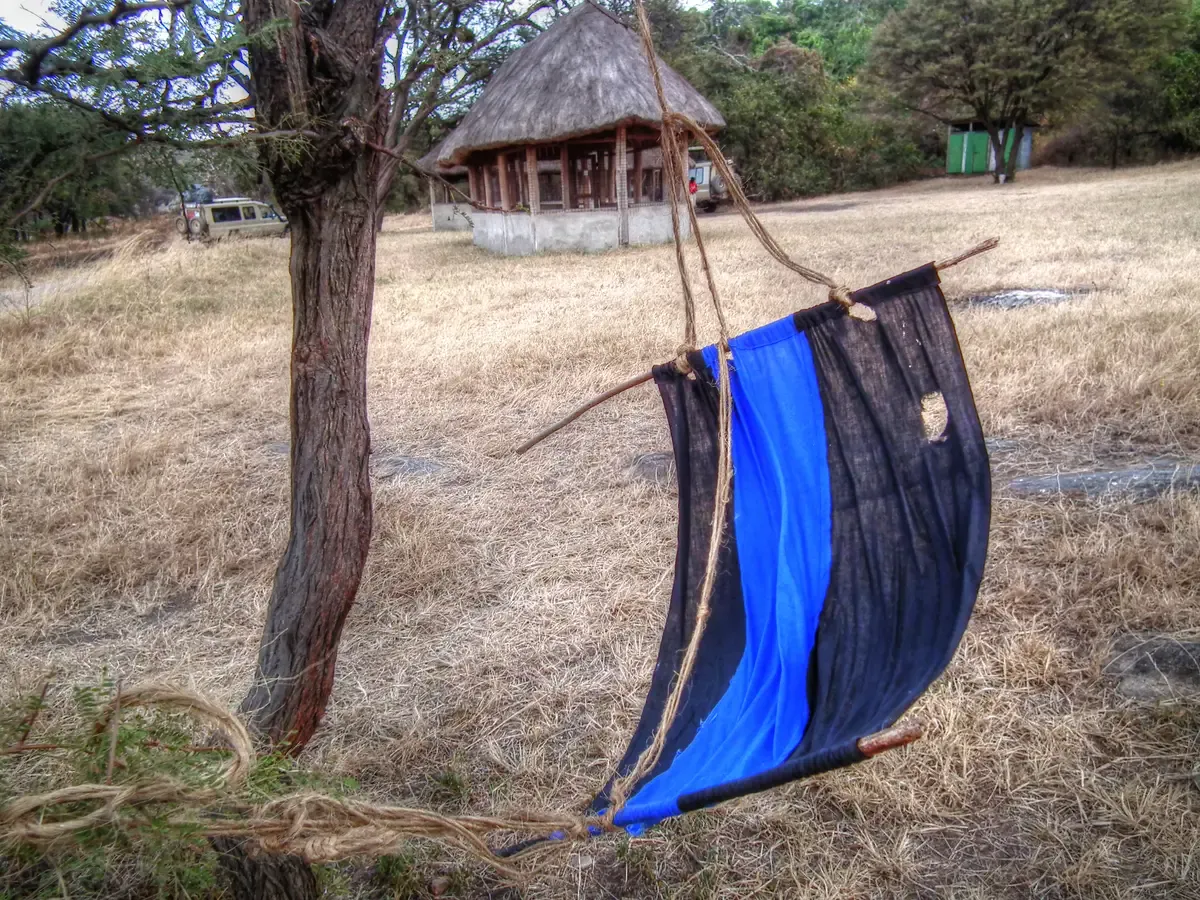
A blue-and-black tsetse trap hung from a tree in Tanzania. Photo: Nevit Dilmen, CC BY-SA 3.0, via Wikimedia Commons
Quick answer Tsetse fly bites, risk and protection
An adult tsetse fly measures 0.5 to 1.5 cm, bites through a long forward-pointing proboscis, and both sexes feed on blood (Wikipedia). The bite is painful, like a deer fly bite. Sleeping sickness risk for short-term safari travellers is low: fewer than 30 cases in travellers from non-endemic countries were published from 2011 onward (CDC MMWR).
Key takeaways
- Wear medium-weight neutral clothing, long sleeves and socks, because tsetse flies bite through thin material and chase blue and black (CDC). See the safari packing guide.
- A 5-day camping safari with a Tarangire day crosses classic tsetse woodland, so pack accordingly.
- No vaccine or preventive drug exists for sleeping sickness, so bite avoidance is the whole defence (CDC). Read sleeping sickness and the real risk.
- Check the park and crater fees before you book, since several listings do not state whether fees are included.
What the Tsetse Fly Is
The tsetse fly is a blood-feeding insect of tropical Africa and a normal part of the woodland safari experience. Knowing its size and habits takes the mystery out of it.
The Basic Numbers
Tsetse flies are all the species in the genus Glossina, which Wikipedia places in its own family, Glossinidae. Up to 34 species and subspecies are recognised depending on the classification used. Both male and female flies feed on blood. The proboscis is a long thin structure attached to the bottom of the head and pointing forward. The table collects the core figures with their sources so you can check them yourself.
A bite usually starts with a warning prick, and Classic Africa Safaris advises swatting quickly at that moment. The bite itself is quite painful and can itch afterwards, and the same operator compares it to North American deer and horse flies. A traveller account on Nomad Travel, written after meeting tsetse in Serengeti National Park, calls the bite particularly painful. If a red sore called a chancre appears within two days to two weeks of a bite, CDC says to seek medical advice, because chancres can be an early sign of sleeping sickness, though they are not always present or noticed.
| Fact | Figure | Source |
|---|---|---|
| Adult body length | 0.5 to 1.5 cm | Wikipedia |
| Recognised species and subspecies | Up to 34 | Wikipedia |
| Feeding | Both sexes take blood meals | Wikipedia |
| Range in Africa | About 15° N in Senegal to 28.5° S in South Africa | Wikipedia |
| Share of blood meals from warthogs (G. swynnertoni) | 60 to 70 percent | Wikipedia |
| Reproduction | Females give birth to one larva at a time | Wikipedia |
Where It Lives on the Safari Circuit
Tsetse live mainly in wooded grasslands and forests across tropical Africa, per Wikipedia. On a northern Tanzania safari that means the woody country rather than the open short-grass plains. Foot Slopes Tours names the wooded areas around Tarangire National Park and Lake Manyara as places where black and dark navy clothing attracts the flies. Tarangire's vegetation of Acacia and Combretum woodland, seasonally flooded grassland and swamps (Wikipedia) is exactly the habitat tsetse favour.
The 2002 CDC Emerging Infectious Diseases report describes nine travellers infected after visiting Tanzanian national parks, and all nine were infected in Tarangire and Serengeti National Parks. Classic Africa Safaris notes that most safari camps apply tsetse control measures nearby, so the flies are rarely a problem in camp. The bite trouble happens on game drives through bush, not around the dinner table.
One reassurance from the field: waterbuck are largely avoided by tsetse because they produce repellent volatiles (Wikipedia), which is one of several chemical cues researchers have studied. Research on attractants has also identified carbon dioxide, octenol and acetone from animal breath. All of this matters to you in one way only: the fly is drawn to hosts that look and smell like animals, and a safari vehicle in tsetse country fits that profile.
Sources: Wikipedia, CDC MMWR, Classic Africa Safaris
Sleeping Sickness and the Real Risk
Sleeping sickness, or human African trypanosomiasis, is the disease behind the tsetse fly's reputation. The numbers show a declining, rare illness with a small risk for safari travellers.
What the Disease Is
WHO says human African trypanosomiasis is caused by protozoan parasites spread by infected tsetse flies and is found in sub-Saharan Africa. Only certain tsetse species transmit the disease, and many areas where tsetse live are free of it. Two forms exist. T. b. gambiense causes 92 percent of reported cases across 24 countries of west and central Africa. T. b. rhodesiense causes 8 percent of reported cases across 13 countries of eastern and southern Africa, and Tanzania is one of those 13 (CDC MMWR). The rhodesiense form is the one a safari traveller could meet, and cattle and wild game are its main animal reservoirs, with CDC MMWR listing impala, lion, waterbuck, zebra, giraffe and warthog among safari reservoirs.
The trend is strongly downward. WHO recorded almost 40,000 reported cases in 1998, with an estimated 300,000 undetected and untreated, then reported cases fell below 2,000 in 2017 and below 1,000 in 2018 and stayed there as of 2022. Sustained control cut new cases by 97 percent over 20 years. CDC MMWR says only 24 rhodesiense cases were reported in the whole of Africa in 2023, in Ethiopia, Malawi, Tanzania and Zambia.
Your Risk as a Traveller
CDC MMWR reports that fewer than 30 cases in short-term travellers from non-endemic countries were published from 2011 onward. That is the scale of the tourist risk. CDC also says travellers to urban areas of sub-Saharan countries are at low risk, while hunters, villagers with infected cattle herds, and tourists or workers in game parks sit in the higher-risk groups. The more often a person is bitten, the greater the risk of infection, and CDC adds that most tsetse flies in rural areas do not carry the parasite.
There is history behind the traveller case count. The 2002 CDC EID report describes nine travellers infected in Tarangire and Serengeti National Parks, seen in February 2001. All nine had fever and most had a trypanosome chancre, and three developed multiorgan failure, with one death. That report recommended sustained tsetse control at Serengeti, Tarangire and Lake Manyara National Parks. Untreated, the outlook is poor: WHO says sleeping sickness is generally fatal without treatment, and CDC MMWR puts approximately 90 percent of untreated rhodesiense cases as fatal. Since 2024, fexinidazole has replaced suramin as first-line treatment for rhodesiense sleeping sickness (Wikipedia), which improves the treatment picture. No vaccine or preventive drug exists (CDC).
Symptoms and When to See a Doctor
CDC says rhodesiense progresses much faster than the West African form, with symptoms appearing about one to several weeks after exposure. Wikipedia adds that it can be fatal within months, and that a skin ulcer may appear at the bite site, most often with the East African form. WHO lists first-stage symptoms as fever, headache, swollen lymph nodes, joint pain and itching. Second-stage symptoms are behaviour changes, confusion, sensory disturbances, poor coordination and a disturbed sleep cycle, which is where the name sleeping sickness comes from.
The practical rule is simple. If you develop fever or any of these symptoms in the weeks after a safari in tsetse country, tell the doctor you were bitten by tsetse flies in a Tanzanian park. Mention Tarangire or the Serengeti by name, because the 2001 cluster shows doctors need that detail to test for trypanosomiasis. Early rhodesiense disease is acute and develops rapidly (WHO), so waiting it out is the wrong move. An animal form of the parasite, T. b. brucei, affects animals but not humans (Wikipedia), and the livestock disease is called nagana. WHO notes the people most at risk are rural residents who depend on agriculture, fishing, animal husbandry or hunting, and the Democratic Republic of the Congo reported 61 percent of cases over the last five years, all of which points away from the short-stay tourist.
TseTse Flies In the Maasai Mara - Preparing for Bugs in the Mara
How tsetse flies behave and how to prepare for bites in the Mara, with advice that carries over to the Serengeti. Third-party video by East Africa Travel Tips. This site did not shoot it and has no relationship with the creator.
Why Blue and Black Attract Them
Tsetse flies hunt with their eyes. Colour and movement decide whether one lands on you, and the science is more interesting than the packing-list folklore.
What the Research Says
Wikipedia says tsetse are attracted to large dark colours such as cow and buffalo hides, and that blue is the key attractant used in traps. That is why simple traps made of blue cloth, in sheet or biconical form, are used to monitor and control tsetse populations. CDC agrees from the traveller side: tsetse flies are drawn to bright colours and very dark colours, so travellers should wear neutral-coloured clothing. Field publishers line up behind this. Duma Explorer ranks the attraction as blue and black first, followed by red, green and yellow. Nomad Travel's author saw flies bite fellow travellers wearing navy. Expert Africa and Tanzania Specialist both state that black and blue clothing attracts tsetse.
The science has a wrinkle. A 2021 PLOS Neglected Tropical Diseases study in Zambia tested all-blue, all-black and 1:1 blue-black vehicle-mounted panel traps and found no significant difference in overall catch between them, though within the blue-black panel the black section caught more tsetse than the blue section. The same study caught 11,342 tsetse in total, 29 percent of them female, and notes a larger moving target is more attractive, which is why a vehicle-mounted trap out-caught a hand-netted black screen by about 2.4 to 2.6 times. The honest summary for travellers: blue and black are the colours most sources warn about, movement matters at least as much, and no colour makes you invisible.
What It Means for Your Suitcase
Leave the navy fleece and the black leggings at home. Foot Slopes Tours adds a second reason to skip black and dark navy on safari: they absorb heat on midday game drives and show dust after a few hours. Duma Explorer notes tsetse attraction also involves movement, heat, dust and carbon dioxide, so neutral clothing reduces attraction but does not prevent bites. That is why coverage matters alongside colour.
CDC advises medium-weight fabric because tsetse flies can bite through thin material, and lists the main prevention as neutral-coloured clothing with long pants, long sleeves and socks. Classic Africa Safaris adds the idea of lightweight gaiters for the ankles. The colour advice here overlaps with general safari clothing rules, and that fuller topic, from layering to camouflage, lives on the what to wear on safari page. If you are still assembling a kit, the safari packing list walks through it item by item. The short version for tsetse country is khaki, olive or beige, medium-weight, with ankles and wrists covered.
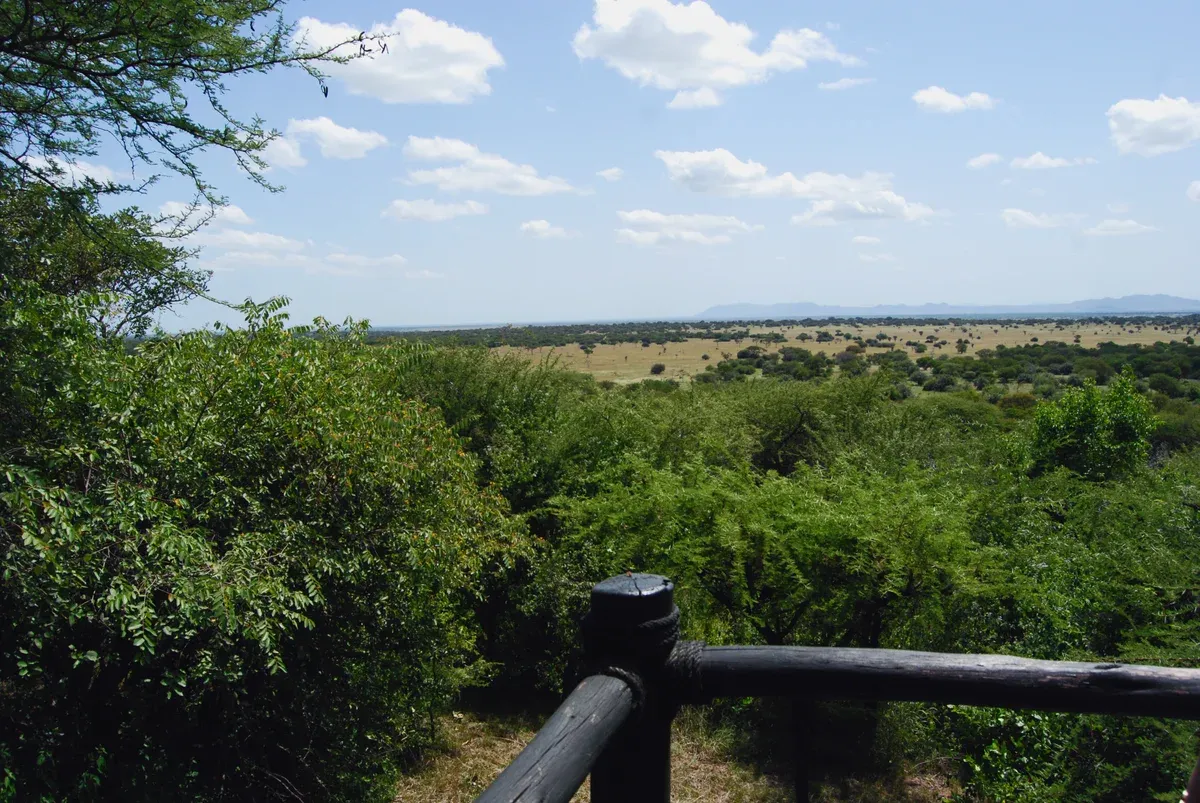
The view from a tent porch at Kirawira Tented Camp in the western Serengeti. Photo: Harvey Barrison from Massapequa, NY, USA, CC BY-SA 2.0, via Wikimedia Commons
Clothes, Repellent and Vehicles
Bite avoidance is the only defence, so it is worth knowing exactly what works. Some of it is not what first-time travellers expect.
What Helps and What Does Not
The CDC list is specific: neutral-coloured clothing, long pants, long sleeves and socks, in medium-weight fabric, because a tsetse can bite through thin material. The CDC MMWR report repeats this and adds two more habits, inspecting the vehicle for tsetse before getting in and avoiding bushes. Classic Africa Safaris advises avoiding blue or black clothing, covering up with long sleeves and trousers, and considering lightweight gaiters for the ankles.
Now the part that surprises people. CDC says insect repellent and permethrin-treated clothing are not especially effective against tsetse flies, though they still guard against other insect-borne illness such as malaria. Classic Africa Safaris is blunter and says no insect repellent is reliably effective against tsetse flies. Ultimate Kilimanjaro still advises DEET at 30 to 50 percent or picaridin plus covering skin and feet, and a repellent remains worth carrying for mosquitoes at dawn and dusk. Treat repellent as a backup layer, not the plan.
On the bite itself, Classic Africa Safaris suggests swatting quickly at the warning prick that comes before a bite and using a topical anti-inflammatory for the itching afterwards. Most camps run tsetse control measures nearby, so evenings in camp are usually calm. The flies you meet are the ones that follow the vehicle through woodland.
Vehicles and the Itineraries That Cross Tsetse Country
CDC says tsetse flies are attracted to moving vehicles and advises checking a vehicle for tsetse before getting in. The research site tsetse.org explains why: flies that follow a moving car are probably tsetse that were sitting and waiting for a host to pass. Practically, that means a quick walk-around and a look at the roof and seats at each stop costs nothing and removes stowaways.
Several itineraries in the catalog spend real time in fly country. The 5-Day Serengeti Camping Safari costs $1,320 per person and adds a full Tarangire day to the Serengeti and the crater, with all fees and taxes listed as included. The 8-Day Serengeti Migration Safari at $4,257 per person for a private party of 2 to 6 adults includes Tarangire plus 2 nights at Heritage Mara Camp in the northern Serengeti, with park fees and taxes included. The Mara River Crossing Safari at $3,763 per person runs 6 days with Tarangire and 3 nights in mobile tented camps that move with the migration, and park fees are included. Whichever trip you pick, the packing rules above do the work: neutral colours, medium fabric, covered ankles, and a vehicle check at every stop.
Sources: CDC, tsetse.org, Classic Africa Safaris
Tsetse Do's and Don'ts
Do
- Do wear medium-weight neutral clothing with long pants, long sleeves and socks, because CDC says tsetse flies can bite through thin material.
- Do check the vehicle for tsetse before getting in, because CDC says the flies are attracted to moving vehicles.
- Do swat quickly at the warning prick before a bite settles in, because Classic Africa Safaris identifies that moment as the chance to stop it.
- Do tell any doctor about tsetse bites in Tanzanian parks if you get a fever in the following weeks, because CDC says symptoms of the East African form appear about one to several weeks after exposure.
- Do keep using repellent and permethrin even though they are weak against tsetse, because CDC says they guard against other insect-borne illness.
Don't
- Don't pack blue or black safari clothes, because Wikipedia and multiple field publishers identify blue and black as the colours tsetse are drawn to, and the CDC warns against bright and very dark colours.
- Don't rely on repellent alone, because CDC says insect repellent and permethrin-treated clothing are not especially effective against tsetse flies.
- Don't skip medical advice if a red sore appears within two days to two weeks of a bite, because CDC says that chancre can mark early infection even though it is not always present.
- Don't assume every tsetse carries disease, because CDC says most tsetse flies in rural areas do not carry the parasite.
Tsetse Fly Questions
What happens if you get bitten by a tsetse fly?
Expect a sharp painful prick, often with itching afterwards, similar to a deer or horse fly bite per Classic Africa Safaris. Swat quickly at the warning prick and use a topical anti-inflammatory for the itch. A red sore within two days to two weeks of a bite deserves a doctor's visit, per CDC. Cover-up strategy starts on the safari packing list.
Which disease is caused by the tsetse fly?
Infected tsetse can spread human African trypanosomiasis, known as sleeping sickness, which WHO says is caused by protozoan parasites and found in sub-Saharan Africa. Only certain tsetse species transmit it. The East African rhodesiense form is the relevant one in Tanzania. Read sleeping sickness and the real risk for the full picture.
How many people are killed by tsetse flies?
Neither WHO nor CDC gives a direct annual death toll for tsetse flies. WHO says sleeping sickness is generally fatal without treatment, and CDC MMWR says approximately 90 percent of untreated rhodesiense cases are fatal. Reported cases fell below 1,000 in 2018 and stayed there, and control efforts cut new cases by 97 percent over 20 years (WHO). Compare trips on the Serengeti safari packages homepage.
What do you do if you get bitten by a tsetse fly?
Classic Africa Safaris advises swatting quickly at the warning prick that comes before the bite and using a topical anti-inflammatory for the itching. Watch for fever or a chancre in the following weeks and tell the doctor where you travelled. The clothing rules that prevent bites are on the what to wear on safari page.
Where in Tanzania will I meet tsetse flies on a safari?
In wooded country: Foot Slopes Tours names the areas around Tarangire National Park and Lake Manyara, and CDC's 2002 report recorded infections acquired in Tarangire and Serengeti National Parks. Camps usually control flies nearby, so the risk is on bush game drives. A trip that crosses this habitat is the 5-Day Serengeti Camping Safari.
Does insect repellent work against tsetse flies?
Not reliably. CDC says insect repellent and permethrin-treated clothing are not especially effective against tsetse flies, though they help against other insect-borne illness. Classic Africa Safaris says no repellent is reliably effective. Clothing colour and coverage do the work, which is why tsetse fly colours matter so much.