 Serengeti Safari Packages
Serengeti Animals: The Wildlife of the Serengeti
The Serengeti animals most visitors want are the Big Five, the big cats and the migration herds. Wikipedia counts about 70 large mammal species and more than 500 bird species in the park. This guide gives the sourced numbers for lions, leopards, hyenas, wild dogs, rhino, giraffe, hippo and crocodile, and explains how a private vehicle, early drives and the park rules change what you see. No guide can promise a sighting. What you can control is where you go, when you drive and how long you stay. Start with the Serengeti safari packages comparison to see which trips give you the most time in the park.
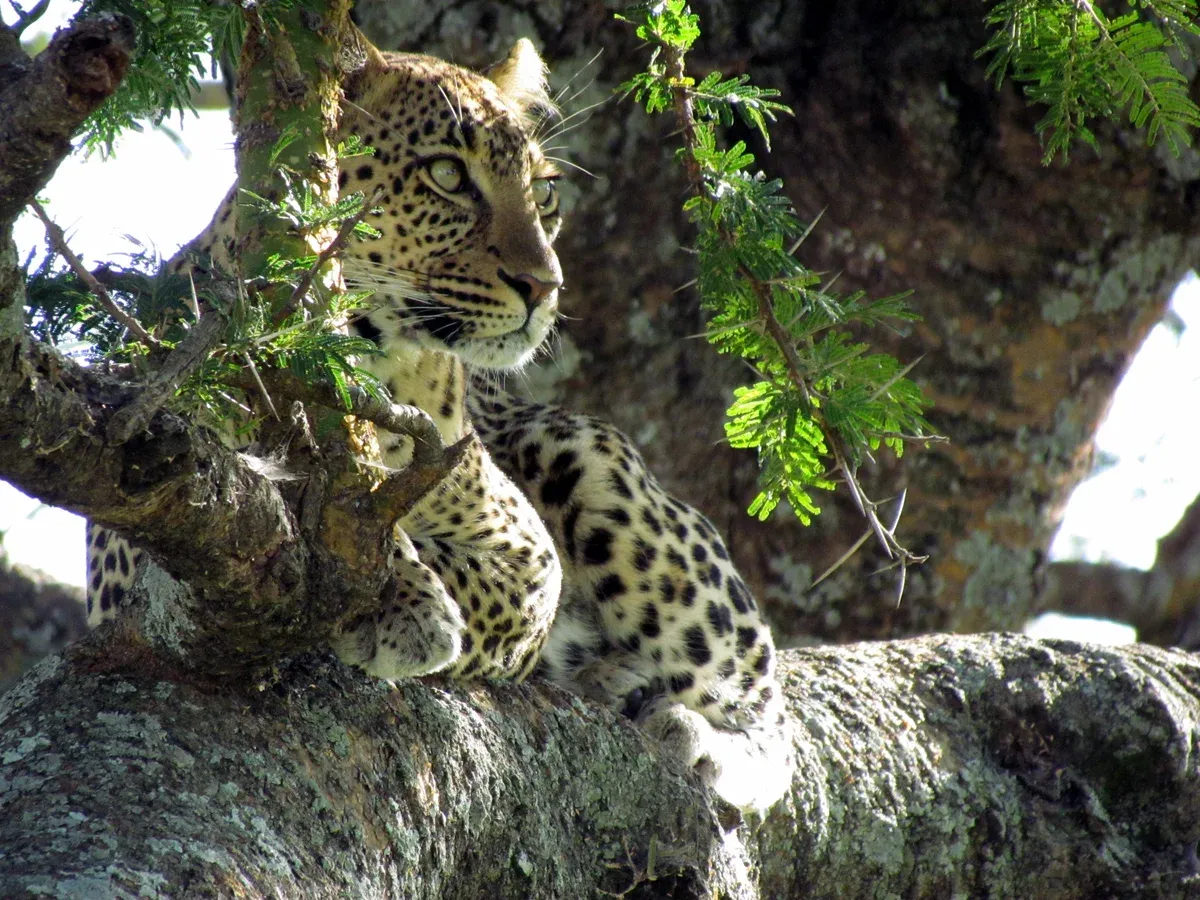
A leopard in a tree in the Serengeti. Photo: David Berkowitz, CC BY 2.0, via Wikimedia Commons
Quick answer The animals at a glance
The Serengeti holds about 70 large mammal species and more than 500 bird species, including over 3,000 lions, 1,000 leopards and 7,700 to 8,700 spotted hyenas. The Big Five are all present, though fewer than 70 eastern black rhino remain.
Key takeaways
- Rhino are the weak link in the Big Five. Look at Moru kopjes or the Ngorongoro Crater, where Duma Explorer counts 26 to 40 black rhinos under ranger guard.
- A private 4x4 lets you stay with animals as long as the rules allow. The 3-Day Private Serengeti Safari is a private vehicle with park fees included at $2,206.35.
- Timing does the rest. See the best time to visit Serengeti and the month-by-month Great Migration Serengeti calendar before you book.
The Big Five in the Serengeti
Lion, leopard, elephant, buffalo and black rhino all live in the Serengeti ecosystem. SafariBookings confirms the Big Five are present but rates the black rhino as rarely seen, so the table below gives the sourced counts.
The Counts and Where to Look
No sighting is guaranteed. Rhino numbers are the smallest of the five by far, and the TANAPA tariff lists a special rhino viewing trip at Moru in Serengeti National Park for US $100 per trip.
The Ngorongoro Crater, inside the Ngorongoro Conservation Area, is part of the same ecosystem. Roadtrip Africa says seeing all five in one crater day is not unusual, and Wikipedia counted about 25,000 large animals on the crater floor. Duma Explorer puts crater black rhinos at 26 to 40 under 24-hour ranger protection.
If the Big Five is the reason for your trip, a short circuit that pairs the park with the crater is the practical shape. The 3-Day Serengeti Big Five Safari covers both for $900 per person with all park and crater fees stated as included.
| Animal | How many | Where to look |
|---|---|---|
| Lion | Over 3,000 in the Serengeti-Maasai Mara ecosystem (Wikipedia) | The crater held 62 lions in 2001 (Wikipedia) |
| Leopard | About 1,000 (Wikipedia), density 5.41 per 100 km² in the dry season | Riverine forest is one of the park's listed habitats (Wikipedia) |
| Elephant | Over 5,000 by 2014 (Wikipedia), over 7,000 per Easy Travel | Counts differ by source |
| Buffalo | 28,524 counted in 2008 (Wikipedia), over 30,000 per Easy Travel | Counts differ by source |
| Black rhino | Fewer than 70 eastern black rhino in the Serengeti (Wikipedia) | Moru kopjes, with a $100 special rhino viewing trip, and the Ngorongoro Crater |
Why the Rhino Is the Hard One
Poaching took the Serengeti rhino population down to about 10 animals in the 1980s. Africa Dream Safaris records a bull named Rajabu walking about 70 miles from the Ngorongoro Crater to reach the last two females at Moru, and says Moru now holds 19 black rhinos. Wikipedia still counts fewer than 70 eastern black rhino for the whole park, while Easy Travel Tanzania claims about 160 without naming a survey.
The honest reading is that the low Wikipedia figure is the sourced one and any rhino sighting is a bonus, not a plan. Budget the $100 Moru rhino viewing trip if a rhino matters to you, or build in a crater day.
Sources: Wikipedia, SafariBookings, TANAPA tariff
Cats, Hyenas and Wild Dogs
The Serengeti is one of the strongest predator systems in Africa. The figures below are the ones the sources actually give.
Lions
Wikipedia counts more than 3,000 lions in the Serengeti-Maasai Mara ecosystem. Easy Travel Tanzania cites the same level and adds pride sizes from 2 to 40 without naming a survey. A 1994 canine distemper outbreak killed about one-third of the lions in the area, which shows how exposed even a large population can be.
No sighting is guaranteed.
Leopards and Cheetahs
Wikipedia gives about 1,000 African leopards for the Serengeti and a dry-season density of 5.41 per 100 km². A 2020 camera-trap study in Biodiversity and Conservation, led by Max Allen of the Illinois Natural History Survey using hundreds of Snapshot Serengeti camera traps, found 5.72 per 100 km² in the wet season and 5.41 in the dry. No cheetah count is given here.
SafariBookings lists cheetah among the park's wildlife.
Hyenas
Wikipedia gives 7,700 to 8,700 spotted hyenas in the Serengeti, a larger population than any of the cat species. Spotted hyena is also named as one of the two main crater predators by SafariBookings alongside lion.
Wild Dogs, a Returning Story
Wild dogs vanished from the park in the early 1990s. Wikipedia says they disappeared in 1991 and returned in 2012, while the University of Glasgow says 1992 and a reappearance east of the park in 2000. By 2015, 66 animals had been reintroduced under the TAWIRI-run Serengeti Painted Wolves Project, and genetic work showed the returning dogs were remnants of the original population with no sign of inbreeding depression.
Easy Travel says wild dogs may be seen in the woodlands along the Grumeti River. Treat a sighting as luck.
Six Cats at Ndutu
Wild Wings Safaris says all six cat species live in the Ndutu area year-round: lion, leopard, cheetah, caracal, serval and African wildcat. Read more in the Ndutu guide.
A Day In The Life Of Serengeti Animals: Serengeti II: BBC Earth Kids
Serengeti animals going about a day, from lions to elephants and antelope. Third-party video by BBC Earth Kids. This site did not shoot it and has no relationship with the creator.
Herds, River Animals and Birds
The grazers far outnumber every predator, and the rivers and the bird list hold animals that many first-time visitors miss entirely.
Wildebeest and Zebra
Wikipedia's Serengeti article gives about 1.7 million wildebeest, 260,000 zebras and 470,000 gazelles, with zebras moving ahead of the wildebeest. Other counts differ: Wikipedia's park article gives more than 1.5 million wildebeest with about 250,000 zebra and 400,000 to 500,000 Thomson's gazelle, and Duma Explorer gives over 1.5 million, around 250,000 and roughly 300,000. The wildebeest is the most common large animal in the park whichever figure you take.
Male blue wildebeest weigh 165 to 290 kg and females 140 to 260 kg, and their predators include lions, cheetahs, leopards, wild dogs, spotted hyenas and Nile crocodiles. The full month-by-month movement is on the Great Migration Serengeti page, and it moves with the rain, so no month is certain.
Giraffe, Hippo and Crocodile
Wikipedia estimated 3,520 Maasai giraffe in 2010, down from 10,750 in 1977, so giraffe are common but declining. Hippos and crocodiles live in the Grumeti and Mara Rivers, as SafariBookings notes, and Wikipedia says about 3,000 Nile crocodiles wait at the Grumeti and Mara river crossings. Wikipedia also lists about 250,000 wildebeest dying on the journey to the Maasai Mara, and the crocodiles take their share at the water.
The Bird List and Its Endemics
Wikipedia counts more than 500 bird species in Serengeti National Park. The Exotic Birding Serengeti checklist goes further, counting 670 species, or 669 excluding vagrants, including 5 endemics and 19 near-endemics. For comparison, nearby parks add range: Tarangire lists more than 550 bird species and Lake Manyara has documented more than 390.
Birders do best with a longer stay and a slower pace, since a checklist that size needs several habitats, from kopjes to riverine forest to the plains.
The Wider List
SafariBookings adds giraffe, cheetah, spotted hyena, black-backed jackal, warthog and many antelope to the Serengeti's wildlife, and rates its wildlife 4.92 out of 5 from user reviews. The park's habitats are riverine forests, swamps, grasslands, woodlands and kopjes, and each holds a different cast. Poaching remains a pressure, with a 2001 study estimating about 200,000 animals killed each year.
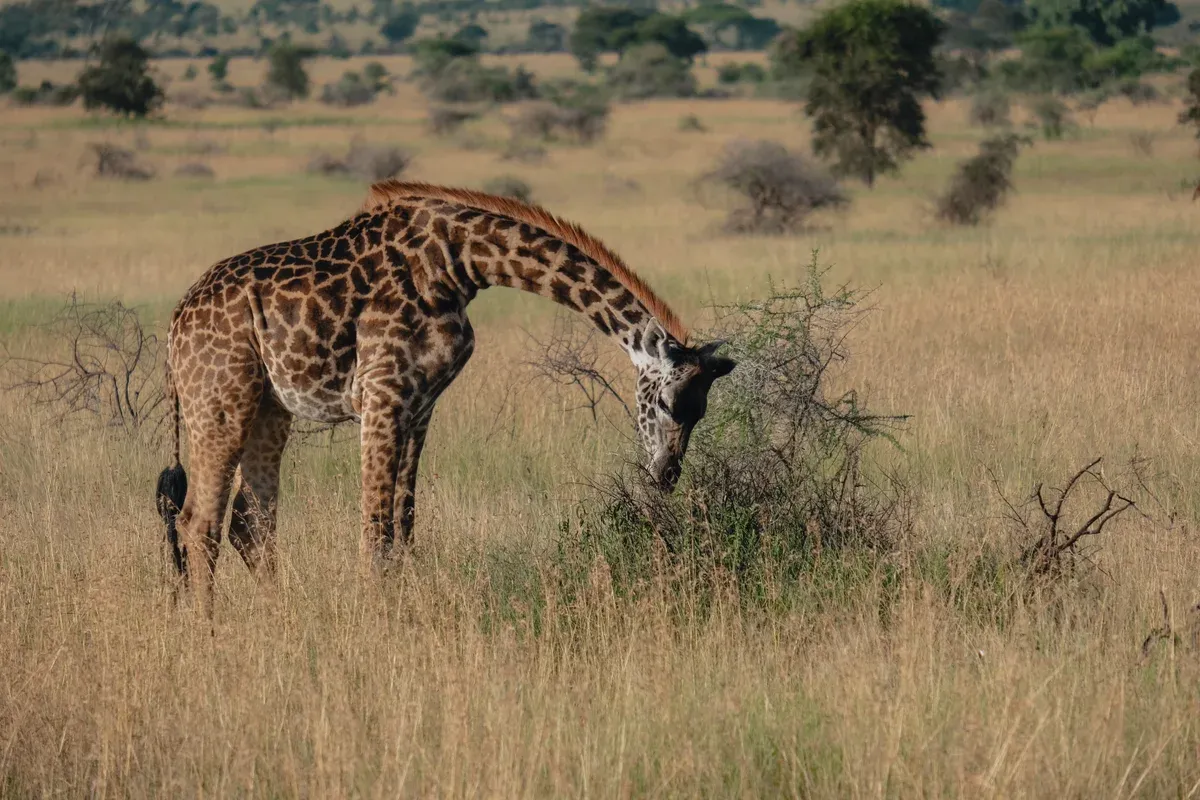
A giraffe feeding in the Serengeti. Photo: Maximilian Staub, CC BY 4.0, via Wikimedia Commons
How to See More
Animal numbers are fixed. What varies is your time in the field, the hour you drive and if you share the vehicle.
Drive Early and Late
Predators hunt in the cool hours and rest through midday, so dawn and dusk drives find the cats moving. A dawn balloon flight over the plains is the extreme version. The Serengeti Balloon Safari runs 5 hours from Seronera for $599 per person, park admission not included, with a minimum age of 7.
The full picture is on the best time to visit Serengeti page.
Private Against Shared Vehicles
A shared vehicle rotates who gets the window and moves on a group schedule. A private vehicle waits as long as the rules allow at a sighting and can steer toward your interests, whether that is a leopard in a tree or a slow morning with the bird list. The price gap is real, and the card prices below are the catalog prices, not operator website quotes.
| Option | Price | What it is |
|---|---|---|
| 3-Day Serengeti Camping Safari | $770 per person | Shared, up to 7 travelers, park fees not stated by the listing |
| 3-Day Serengeti Big Five Safari | $900 per person | Shared, 12 participants, all park and crater fees included |
| 3-Day Private Serengeti Safari | $2,206.35 per person | Private 4x4, 2 to 7 per booking, park fees and taxes included |
| 5-Day Serengeti Ngorongoro Safari | $2,845 per person | Private, 2 to 7 adults, park fees not stated by the listing |
The Rules That Protect the Sighting
The NCAA rules for the conservation area require a licensed guide for all visitors to the crater and Olduvai Gorge, limit vehicles to five around one animal or kill, and ban dogs in the crater. Nobody may enter the Lerai or Layanai forests. Off-road driving is not allowed in the conservation area, and Altezza Travel says guides in the national parks stay on the park roads too.
Where sources conflict on speed limits, one gives 50 km/h in national parks and 25 km/h in Ngorongoro and another gives 25 to 40 km/h depending on road and park. Staying with the vehicle and keeping distance is what keeps animals in view for the next vehicle too.
Do and Don't
Do
- Do plan a Ngorongoro crater day alongside the Serengeti, because Roadtrip Africa says seeing all of the Big Five in one crater day is not unusual and Duma Explorer counts 26 to 40 protected black rhinos on the floor.
- Do book the $100 special rhino viewing trip at Moru if a rhino is the missing tick, because Wikipedia counts fewer than 70 eastern black rhino in the whole park and a chance encounter is not a plan.
- Do take dawn and dusk drives, because predators hunt in the cool hours and the same park holds over 3,000 lions and 1,000 leopards that rest through midday.
- Do allow enough days for the bird list, because the checklist reaches 670 species with 5 endemics and a rushed circuit covers only one or two habitats.
- Do confirm which fees are included before you pay, because some listings state park fees clearly and others do not state them at all, so ask the operator in writing.
Don't
- Don't treat migration timings as a schedule, because African Overland Tours calls them an expert estimate and Duma Explorer says the movement is driven almost entirely by rainfall.
- Don't expect a river crossing on demand, because Duma Explorer says no safari operator can guarantee one and animals may wait days before crossing.
- Don't leave the vehicle or push closer than the rules allow, because the NCAA limits vehicles to five around one animal or kill.
- Don't count on seeing a cheetah in numbers, because no sourced population count exists for the Serengeti and it is absent from the confident lists that give lion and leopard figures.
Serengeti Animals FAQ
What is the most common animal in the Serengeti?
The blue wildebeest. Counts range from more than 1.5 million to about 1.7 million animals depending on the source, against 260,000 zebra and 470,000 gazelles in Wikipedia's widest count. The herd is the subject of the Great Migration Serengeti page.
What are the Big Five animals found in the Serengeti National Park?
Lion, leopard, elephant, buffalo and black rhino. SafariBookings confirms all five are present but notes the rhino is rarely seen, and Wikipedia counts fewer than 70 eastern black rhino. See the counts in the Big Five table above and the Serengeti National Park guide.
Are there giraffes in the Serengeti?
Yes. Wikipedia estimated 3,520 Maasai giraffe in 2010, down from 10,750 in 1977. They are common across the park, though giraffe are notably absent from the Ngorongoro crater floor. The crater is covered in the Ngorongoro Crater guide.
How many leopards are in the Serengeti?
Wikipedia gives about 1,000 African leopards, with a dry-season density of 5.41 per 100 km². A 2020 camera-trap study found 5.72 per 100 km² in the wet season and 5.41 in the dry. The park itself is covered in the Serengeti National Park guide.
Where can I see rhinos in the Serengeti?
Moru kopjes and the Ngorongoro Crater. Africa Dream Safaris says Moru now holds 19 black rhinos, the TANAPA tariff lists a special rhino viewing there at US $100 per trip, and Duma Explorer counts 26 to 40 crater rhinos under ranger protection. The Big Five package in the comparison is the 3-Day Serengeti Big Five Safari at $900 per person with fees included.
What birds can I see in the Serengeti?
Wikipedia counts more than 500 species and the Exotic Birding checklist reaches 670, including 5 endemics and 19 near-endemics. Birding rewards a slower pace and a private vehicle, which is why a private trip such as the 3-Day Private Serengeti Safari suits birders better than a shared circuit.